


Card author:
Location:
Date:
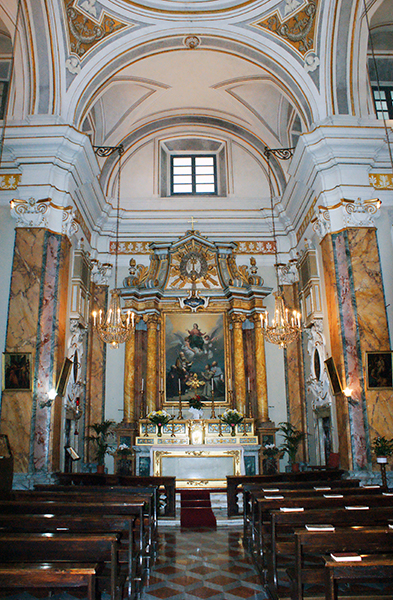

The church of Saint Andrea, one of the oldest in Montefiascone, was first mentioned in 853 as ecclesiam S. Andreae in Campo (latin name). The building, located close to the primitive circle of walls, was to present the typical three-gabled conformation, and the coverage of the aisles that are lower than the nave.
Info: Parrocchia Tel. 0761/826050.


CHURCH OF SAINT ANDREA IN CAMPO
THE HISTORY
The church of Saint Andrea, one of the oldest in Montefiascone, was first mentioned in 853 as ecclesiam S. Andreae in Campo (latin name). The building, located close to the primitive circle of walls, was to present the typical three-gabled conformation, and the coverage of the aisles that are lower than the nave. This is also reflected by the traces of clerestory visible on the inside. The aisles were later incorporated in the surrounding buildings and today only the central part of the façade remain free and is characterized by the door redesigned in the Gothic style and the rose window. The opposite wall, an apse, is visible from Piazza Vittorio Emmanuele. The building had its moment of importance during the 1000’s when justice and meetings were held in the opposite square. The two epigraphs with coat of arms on the façade are in memory of the agreements reached with neighboring towns and document political significance of the community. The construction of a well, the only water source within the city walls, added strategic value and is symbolic of the small Piazza of Plebiscito. In 1702 the priest’s house was built to the right of the church. The new construction led to the two windows on the right of the central nave.
DESCRIPTION
On the right side of the church’s façade is a peperino stone plaque dating back to 1305. On top is the oldest existing coat of arms in Montefiascone, bordered by two other coat of arms that are no longer recognizable, on top is an inscription that alludes to the agreement with the neighboring countries for territorial issues which, however, were not kept. A cause for which the tablet and coat of arms were removed. To the left of the façade are three more coat of arms. The first is that of Montefiascone, the others are unrecognizable. Their dates coincide with that of the plaque to the right of the entrance. The interior, lined with three naves, is divided by columns and pillars and embellished with four capitals of Lombard influence from the pre-Romanesque era. The first capital of the right nave is in the Corinthian style. The second has a carved bird with a long neck and serpentine tail. The first of the two capitals in the left nave has a human face carved into each corner, while the second is decorated with animal figures spaced out on the corners by large palm leaves. The two closest columns to the altar were most likely replaced in 1702, during the construction of the church’s rectory.
ST. ANDREA CHURCH
It is one of the most antique churches in Montefiascone and it is situated near the original town walls. The original construction showed besides the central aisle, other two side aisles having a lower roof. Later the neighbouring buildings absorbed the aisles and today just the central part of the façade – characterised by the Gothic portal and the rose – is not part of other constructions. Rude columns and pillars divide the nave and the two aisles; the four capitals have very essential decorations and an ancestral power. This helps in dating the church back to the pre-Romanesque period.
ESSENTIAL BIBLIOGRAPHY
G. Breccola – M. Mari, Montefiascone, Grotte di Castro 1979.
C. Sensi, Montefiascone medievale. Gli edifici del centro storico, tesi di laurea, Università degli Studi della Tuscia di Viterbo, A.A. 1996-1997.
G. Breccola, Altre emergenze in Montefiascone. Emozioni storie e colori, vol. II, Viterbo 2000, pp. 111-116.
G. Breccola, Montefiascone. Guida alla scoperta, Montefiascone 2006.
Montefiascone Artecittà – Chiesa di Sant’Andrea. Montefiascone città d’arte, cultura e tradizione.


