


Card Author:
Location:
Date:

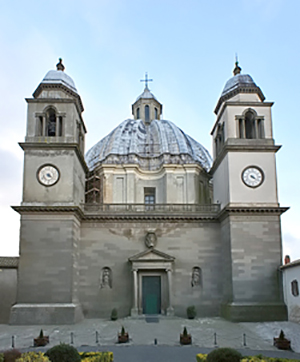
The façade, designed by Gazola, fastened between two bell towers and topped with a balustrade, presents a solemn neo-classical portal composed by a triangular pediment supported by ionic columns, surmounted by the coat of arms of Cardinal Macchi. On the sides are two niches housing the statues of San Flaviano e Santa Margherita, patrons of Montefiascone.
Info: Parish (tel. 0761.826050) Hours: 9-12 / 15-18 Every day


CHURCH CATHEDRAL OF SAINT MARGHERITA
HISTORY
Towards the end of the fifteenth century, the clergy and people of Montefiascone felt the need to completely reconstruct the church which contains the relics of Saint Margaret. The church was unfit to receive the Bishop, according to Urbano V in 1369. The formal construction of the Cathedral of Montefiascone began at the end of ‘400, according to references attributed to Michele Sanmicheli (which is not very likely because the architect in question at the time was only a child) with the possible collaboration of Antonio da Sangallo the Younger. The heavy commitment of the works proceeded slowly and only in the early years of the 17th century it was possible to cover the building, reached the height of the tambour, with a roof that replaced the outer dome provided by Sanmicheli. The fire, in 1670 on Good Friday, destroyed the interior of the church and the roof, it was an opportunity to re-start the work and so the bishop Paluzzo Paluzzi Albertoni gave the task to the architect Carlo Fontana to create the dome in the project of the Sanmicheli, who liked Baroque and Borromini’s works. Fontana modified the original design and built a dome closer to the aesthetic needs of the time. The great dome, covered with lead and characterized by fluted ribs, was opened on December 16, 1674. The bell towers and the façade, seemingly simple, however were designed in 1840 by architect Paolo Gazola, commissioned by Cardinal Vincenzo Macchi to finish the important building. In 1890, at the will of Bishop Alessandro Spoglia, the painter Luigi Fontana painted the pictorial and sculpture of the Cathedral.
DESCRIPTION
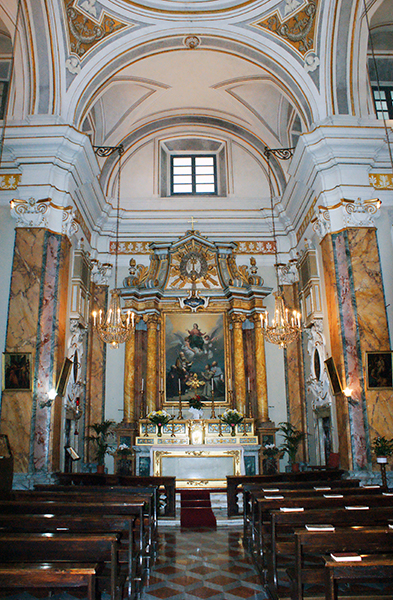
The façade, designed by Gazola, fastened between two bell towers and topped with a balustrade, presents a solemn neo-classical portal composed by a triangular pediment supported by ionic columns, surmounted by the coat of arms of Cardinal Macchi. On the sides are two niches housing the statues of San Flaviano e Santa Margherita, patrons of Montefiascone. The octagonal interior with radial chapels and surmounted by a monumental dome, looks grand and harmonious. The first chapel on the right is dedicated to Saint Martino. In a seventeenth century painting above the altar, attributed to the painter Bernardino Gagliardi, depicting S. Martino vescovo, S. Martino di Tours, an unidentified saint and the Virgin surrounded by angels. On the sides of the tombstones of Valerio Tartarino, Bishop of Alatri, a native of Montefiascone, and Monsignor Girolamo Bentivoglio, bishop of the diocese from 1580 to 1601. The altar of the following chapel, originally dedicated to St. John the Baptist, then entitled to Saint Vincenzo in the eighteenth century, presents a painting of La Madonna con Bambino (Mary with Child) between Saint Elena empress, Saint Vincenzo Ferreri, and other saints. The third chapel holds an ancient wooden crucifix, which miraculously escaped the fire of 1670, it became an item of special devotion. The large chapel of the biggest altar, dedicated to the martyr Saint Margherita preserved in a niche supported by four columns, a marble statue of the patron saint. The oval paintings on the sides are painted by Pietro Gagliardi and depict Saint Flaviano and Saint Felicita, patrons of the city. At the top stands the figure of Christ the Redeemer, while the frescoes of the two lateral lunettes depict personifications of Faith and Charity. Other decorative paintings of biblical characters adorn the turn. All the frescoes of the chapel date back to 1890 and were done by the painter Luigi Fontana, commissioned by Bishop Alessandro Spoglia. Fontana also did paintings and sculptures of the tambour and dome. One can see the first chapel dedicated to Mary of the Rosary on the left, then that of the Sacrament, embellished by a glazed terracotta window of Robbia style, done by Benedetto Buglioni, depicting Mary enthroned between Saint Benedetto and Saint Bibiana. Five tile platforms reproduce scenes inspired by the birth of Jesus. On the sides of the terracotta are two frescoes depicting The apparition of Jesus to Saint Margherita Alacoque on the right. The last chapel, dedicated to Saint Giuseppe, holds a painting which depicts The Death of the Saint, painted by Mattia Alessandri. The decorative painting and sculpture of the tambour consists of some scenes of the martyrdom of three patrons of the city and two historical events that occurred during the stay of Pope Urbano V in Montefiascone. On the sides of each fresco statues of the four Evangelists and of the Apostles are located in many niches, while the lower side of the arches of the four chapels of the Fathers of the Church busts are alternating the statues of the angels: Faith with the cross, Hope with the anchor, Charity with the torch, The Truth with the trumpet. Above the central arch are two angels holding up the coat of arms of Cardinal Ascanio Sforza, while on the entrance is the emblem of Clemente X, the pope who financed the construction of the dome, and the coat of arms of Pope Leo XIIII and Bishop Gentilucci. On the top of the base of each rib are statues of eight angels symbolizing The Virtues or Beatitudini introducing the decoration of the great dome.
THE TREASURE
Over the centuries, thanks to donations and wills, the Cathedral Chapter has accumulated an authentic treasure composed of paintings, sculptures and ornaments, including a marble statue of Saint Margherita of the thirteenth century, attributed to Arnolfo of Cambio; three silver busts of Saint Margherita, St. Flaviano and Saint Felicita dating back to the fifteenth and sixteenth centuries. A picture of the painter Sebastiano Conca depicts the marriage of Giacomo III of England with the Polish princess Maria Clementina Sobieskaj, celebrated on September 1, 1719 at the bishop’s palace of Montefiascone. Embroided silk robes in gold, stitched by the Queen Sobieskaj who then donated the robes to the Cathedral.
ST. MARGHERITA CATHEDRAL
St. Margherita Cathedral is clearly visible from all parts of the Town, given its size. Its majestic dome is actually the third largest in Italy for its internal diameter after Saint Peter’s in Rome and Saint Mary’s in Florence. The history of this huge building dates back to the end of the XV century when the foundations were laid with an octagonal base. The first project of the church was developed by the architect Michele Sanmicheli, probably with the collaboration of Antonio da Sangallo il Giovane. In 1670 a violent fire destroyed the roof and the interior, but within a few years the structure was saved and restored. The interior is richly decorated with paintings of 1800 and contains a marble bust depicting St. Margherita attributed to Arnolfo di Cambio. The huge dome was designed by Carlo Fontana and the two bell towers were added in 1840 by the architect Paolo Gazola. In the lower church you can visit the “Cripta di Santa Lucia Filippini” which reveals the style of Bramante experiences. Besides the body of the Saint placed in the urn beneath the central altar, the cript contains the remains of Cardinal Marco Antonio Barbarigo, founder of the Montefiascone Seminary and the Bishop of the local diocese from 1687 to 1706. In the niches in the perimeter, a monumental Via Crucis has been recently placed consisting of 15 sculptures in terracotta, the work of the maestro Mario Vinci. In the side aisle below the choir stalls is the chapel of the baptismal font.
Church of Saint Margaret (Cathedral)
Translation by Michelle Greif, University of Iowa, enrolled in the USAC Viterbo program.
ESSENTIAL BIBLIOGRAPHY
ANTONELLI M., Le tre chiese monumentali di Montefiascone: S. Flaviano – S. Andrea – S. Margherita, “La Vergine delle Grazie” (1905-1906).
BRECCOLA G., Montefiascone. Guida alla scoperta, Montefiascone 2006.
BRECCOLA G., Santa Margherita. Guida alla scoperta, Montefiascone 2008.
BRECCOLA G. – MARI M., Montefiascone, Grotte di Castro 1979
BRUSCHI A., Un intervento di Bramante nella Rocca di Viterbo, “l’Arte” (1972), XV.
DE ANGELIS, GIROLAMO, Comentario Storico Critico sull’origine e le vicende della Città e Chiesa Cattedrale di Montefiascone, Montefiascone 1841.
FAGLIARI ZENI BUCHICCHIO, Il soggiorno di Sanmicheli nello stato della chiesa, in Michele Sanmicheli. Architettura, linguaggio e cultura artistica nel Cinquecento, Milano 1995.
FAGLIARI ZENI BUCHICCHIO, Dal duomo di Montefiascone a San Giovanni in Val di Lago: architetti rinascimentali e chiese a pianta centrale intorno al lago di Bolsena, “Bollettino di Studi e Ricerche della Biblioteca Comunale di Bolsena” (1989).
FONTANA C., Discorsi e Dichiarazioni. Dichiaratione dell’operato nella Cuppola di Monte Fiascone, Modena, Bibl. Estense, fondo Giuseppe Campori, 379.
FROMMEL C.L., Sant’Egidio a Cellere: funzione, tipologia e forma, in All’ombra di “sa’ gilio a celeri di farnesi, Cellere 2001.
HAGER H., Die Kuppel des Domes in Montefìascone, in Römisches Jahrbuch für Kunstgeschichte, vol. 15, 1975.
MUSIARI A. – COCCIOLI MASTROVITI A., Classicismo e purismo nell’opera di Paolo Gazola: la facciata di S. Margherita a Montefiascone, in Arte e Accademia ‘89, Viterbo 1990.
MUSOLINO G., Montefiascone e la basilica di S. Margherita, Montefiascone 1992.
OST H., Santa Margherita in Montefiascone: A Centralizated Building Plan of the Roman Quattrocento, “Art Bulletin” (1970), LII.
RONZANI F – LUCIOLLI G., Le fabbriche civili, ecclesiastiche e militari di Michele Sanmicheli, Verona 1823.
SERRA A., L’attività giovanile di Michele Sanmicheli e di Carlo Fontana in Santa Margherita a Montefiascone, “Annuario Istituto di Storia dell’Arte”, Roma 1973-74.
Montefiascone Artecittà – Chiesa di Santa Margherita.
Montefiascone città d’arte, cultura e tradizione.


