


Card Author:
Location:
Date:

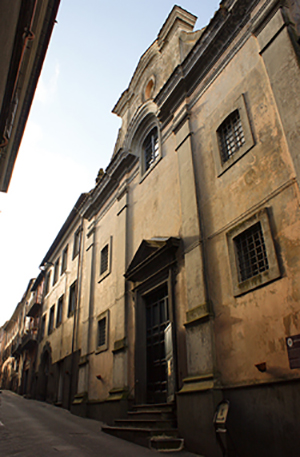
The church, dedicated to Santa Maria Assunta, belongs to the Monastery of Divine Love of the Augustinian nuns. These nuns became cloistered December 31, 1721 and then dissolved at the beginning of the last century. Since 1986 this monastery has been the center for religious training.
Info: Congregazione delle Suore Agostiniane dell’Istituto del Divino Amore (A.D.A.); Tel. 0761 826089







THE CHURCH OF DIVINE LOVE
THE HISTORY
The church, dedicated to Santa Maria Assunta, belongs to the Monastery of Divine Love of the Augustinian nuns. These nuns became cloistered December 31, 1721 and then dissolved at the beginning of the last century. Since 1986 this monastery has been the center for religious training. The primitive church , formerly known as San Giovanni in Borgo was almost entirely abandoned at the end of the 16th century. In 1615 the Authority of the Cathedral gave it to the Confraternity of Saint Maria of Strength and the Pestilence. However, the Authority reserved direct rule over the church. This is when it was given the name Saint Mary of Strength and restorations on the building began. The new building had a rectangular plan and on the façade there was a large circular window. The altar was erected opposite the entrance. Behind the altar is a painting of Virgin and Child with St. Charles and Saint Lucia. The present appearance of the building — the elegant dome and the interior decoration — is the result of the intervention of Bishop Saverio Giustiniani ( 1 753-1771 ).
DESCRIPTION
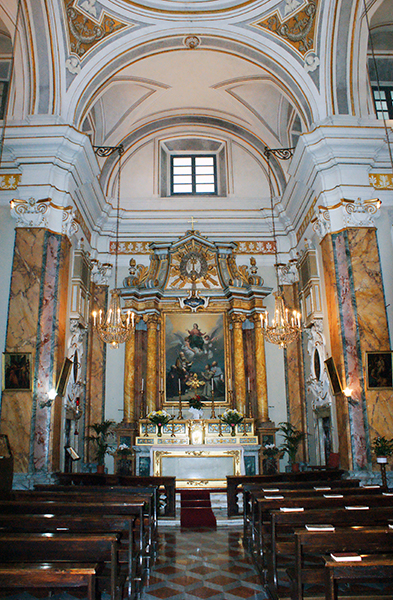
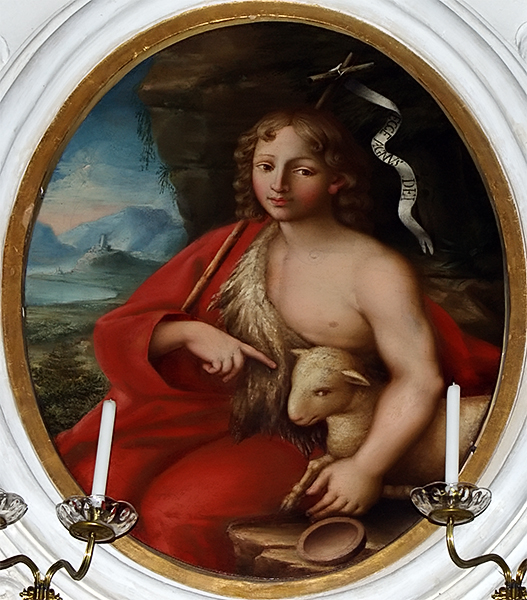
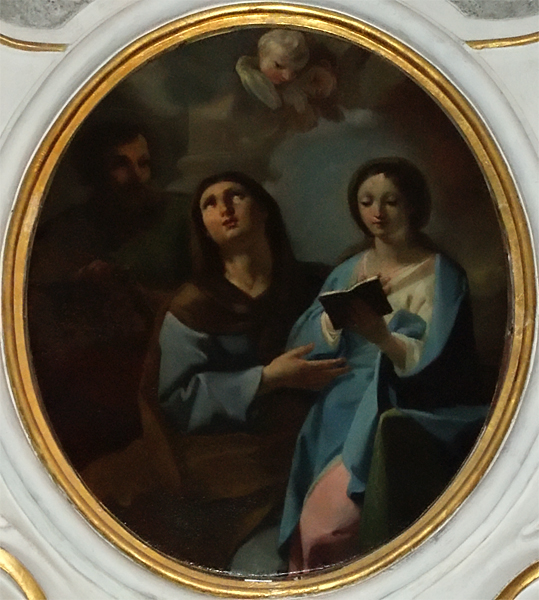
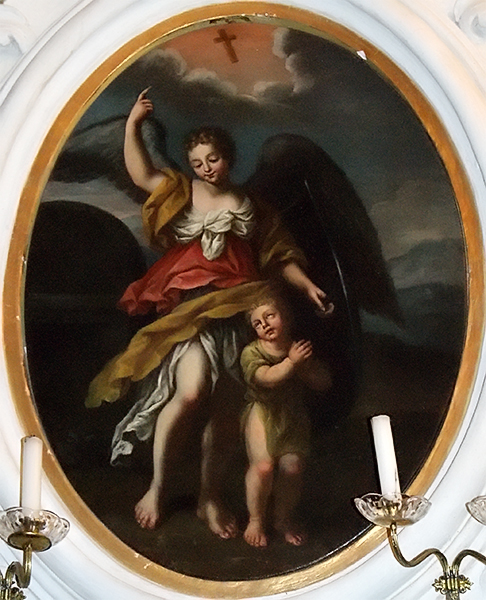
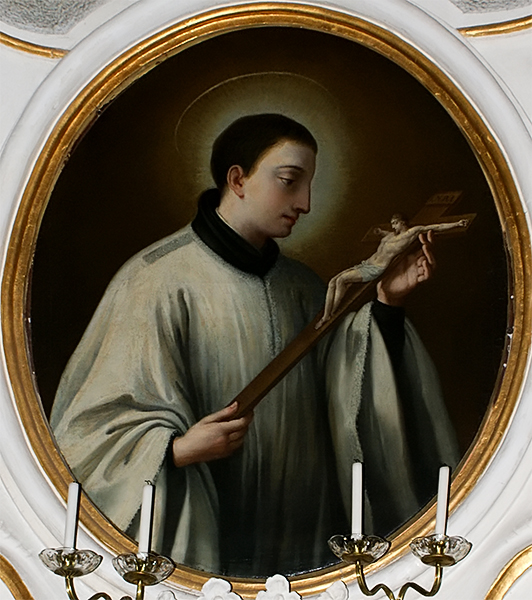
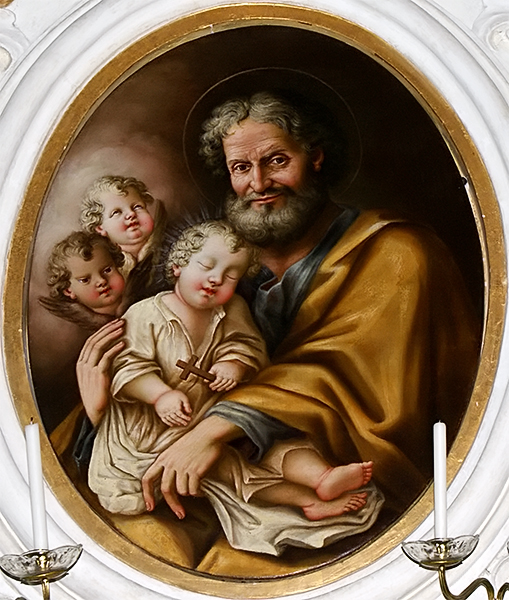
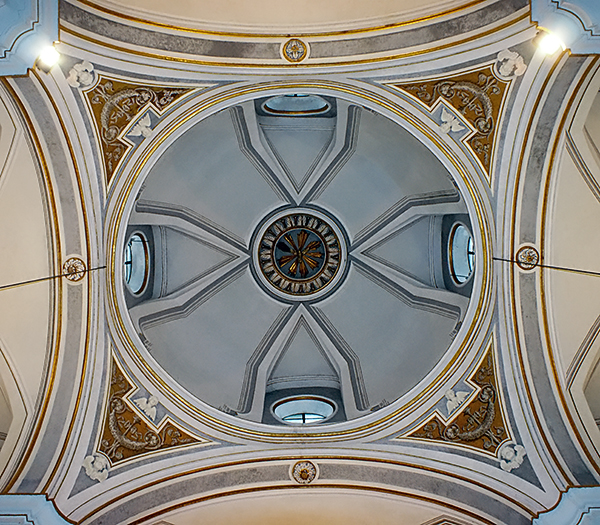
The surface of the façade is spanned vertically by four pilasters, which connect the plinth with the projecting frame that separates the lower level from the upper one. The four windows do not illuminate the interior of the church, but other adjacent rooms. Instead, the light that filters through the central window illuminates the interior. After crossing the small doorway, over which is a triangular pediment, the church has a single room and the walls are made of stucco and polychrome marble. To the right is the Monumento funebre di Biagio Morani (the tomb of Biagio Morani), which consists of a shield that contains the relief bust of the deceased over which is a strip of gold plated stucco and below which is a scroll with a commemorative inscription. On the adjacent doorway is an oval canvas from the 18th century depicting St. John the Baptist with a large, white stucco frame decorated with scrolls, floral motifs and heads of angels. The altar on the right contains a painting depicting the Virgin and Child with St. Charles Borromeo and Saint Lucia . The painting, which was located on the main altar before the renovations of the 18th century, dates from the second half of the seventeenth century. On the sides of the alter are two small oval paintings from the eighteenth century. These are framed in white stucco frames decorated with scrolls. The painting on the right depicts the Education of Young Mary while the one on the left shows the Virgin, the Child, and Saint Rosa. The high altar is made up of four columns with Corinthian capitals supporting a central element, inside which is a lunette, surrounded by heads of angels. The nineteenth-century painting inside the lunette depicts the Virgin and Saints Augustine, Ignatius, Francis de Sales and Benedict Joseph Labro. The small oval canvas to the right of the main altar, framed in white stucco decorated with scrolls, depicts The Guardian Angel , while the painting on the opposite side shows Archangel Michael. Both paintings are of the late eighteenth century. The spherical cap of the dome has four oculi and the center of the dome has a stucco decoration of plant motifs that surrounds the image of the Holy Spirit. The plumes, on the other hand, are decorated with scrolls, floral patterns and the heads of angels in stucco. The altar on the left , which is identical to the one on the opposite side, holds an 18th century painting depicting the Virgin and Child with St. Francis and St. Clare. To the right and left two small oval paintings from the 18th century depict, respectively, St. Aloysius Gonzaga and St. Cecilia among the angels. Both of these are also in stucco frames. Finally, on the door of the left wall hangs another oval painting from the eighteenth century depicting St. Joseph with the Child. Opposite this painting is a compass carved from walnut whose structure is laterally defined by four pilasters with Corinthian capitals.
Montefiascone, The Church of Divine Love.
Translation by Clare Kuntz, Goucher College, enrolled in the USAC Viterbo program.
ESSENTIAL BIBLIOGRAPHY
G. Breccola – M. Mari, Montefiascone, Grotte di Castro 1979.
G. Breccola, Montefiascone. Guida alla scoperta, Montefiascone 2006.


